
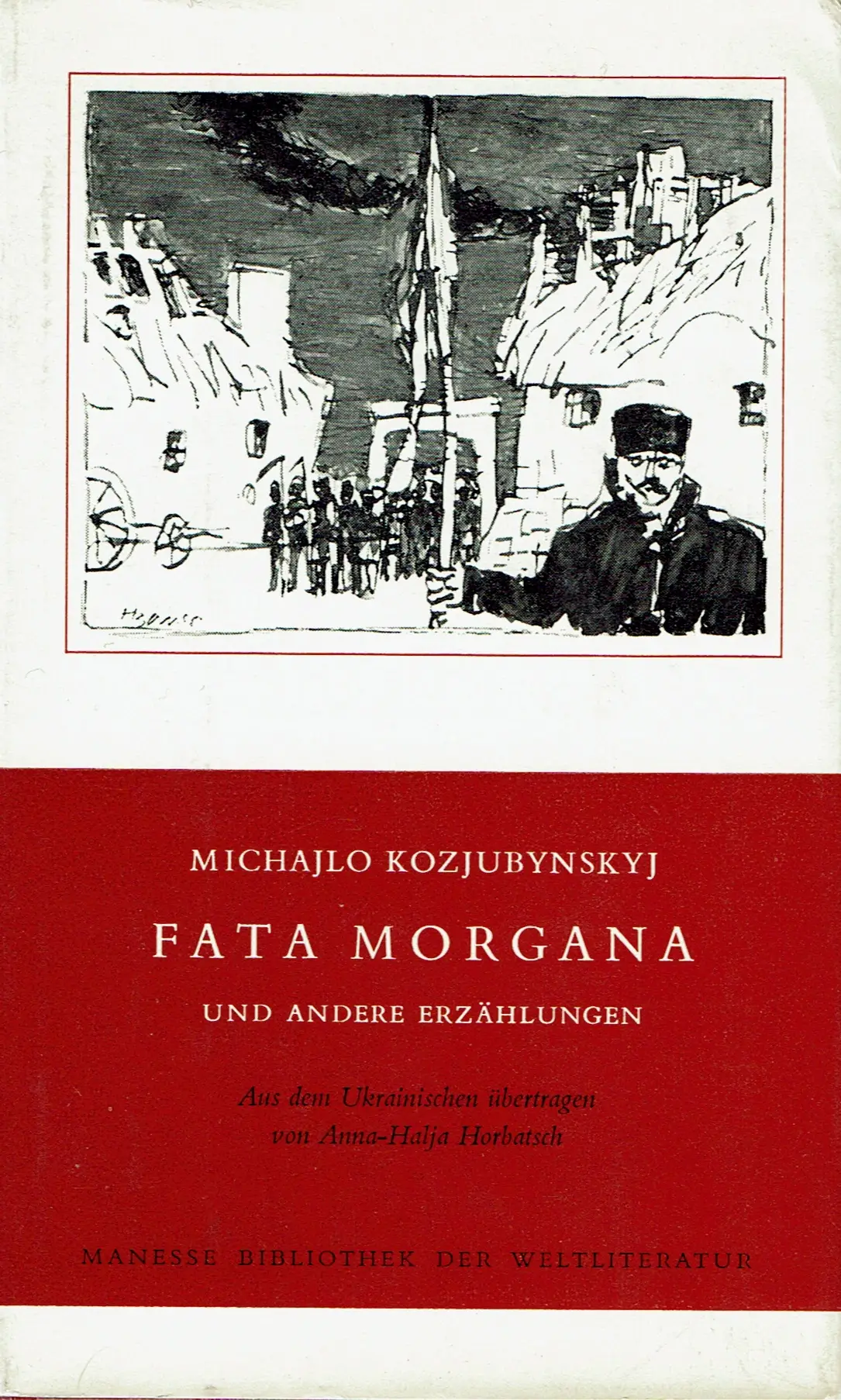


Insight into the Mechanisms of an Uprising: Fata Morgana
by
Ursula Kampmann

We find ourselves somewhere in the vast expanse of the Russian Tsarist Empire. There is this village, a village like so many others at the time. There are the peasants who own just enough land to get by with hard work. There are the day labourers who do not know how to feed themselves and their children. And there is the Wolyk family, through whose fate Mykhailo Kotsiubynsky exemplarily shows what hopes keep the poorest of the poor alive.
Let us begin with the mother, Malanka. She is old and worn out, exhausted from her hard life as a servant. How she envied her employer! To own land of one's own -- that is the goal of her wishes. Her husband Andriy has entirely different wishes. He repeatedly walks past the burned-out sugar factory. What a wonderful life it was back then, when he still worked in the factory. Thirteen roubles a month! Enough money for beer and vodka! What would he not give for the master to reopen the factory at last and give him well-paid work. He would be the most diligent of all workers! And then there is the daughter Hafiyka, a strikingly beautiful girl, cared for and nurtured by her mother. She is meant to have a better life! She is to marry Prokip! He is a peasant, has a small farm. It is the mother's dream to work the little farmstead together with her daughter and Prokip. But Hafiyka has other plans. She has taken a liking to the student Marko. He speaks so beautifully of a just world in which everyone cultivates the land together and there are neither poor nor rich.
This is the starting situation the landowner encounters when he begins to rebuild the factory. Andriy is enthusiastic! He is the right-hand man of anyone who lets him be their right-hand man. No work is too hard for him. Naturally he receives a well-paid post in the factory. And then the accident. He loses three fingers in the machine. He can no longer be of use as a right-hand man. The factory owner takes responsibility. He sends him to the doctor, pays the bill, and gives Andriy a severance payment. That is more than many others would have done. It is not enough. For Andriy it is over. No more regular income. The dream has burst. Poverty returns. Hope is gone.
Suddenly Andriy no longer objects to his daughter Hafiyka's friendship with the student Marko. He himself likes to listen to him. But he prefers meeting with the half-mad Choma, that shepherd who has stopped being a shepherd because he can no longer bear the life with the animals. He wants to burn everything those who forced him to become a shepherd possess. Burn it all! That is his answer to everything. Burn it! For only thus does one harm the upper classes. That destroyed property is no longer of use to anyone does not interest Choma. He wants the conflagration of the world!
How then does the uprising actually come about? Does it begin with the strike of the harvest workers, who attempt to force the landowner to comply with their wage demands? Or are it the fires that devour a little more of the manorial estate each night? Do the reports from surrounding villages give the courage to resist? Or is it everything together that drives the village into the uprising? They want to own land. Not someday, but now. And so they confiscate the master's estate.
It goes relatively peacefully. The steward can save his life. Ah, how beautifully things could continue now. What a happy ending! Peasant Prokip takes over the estate and turns it into a model farm for the good of the village. So carefully tended, the harvest promises to protect all the village families now and forever from hunger. But Choma, the mad shepherd, has a different view of the world: he already sees the master returning with soldiers. Reclaiming his property. Spitting on the stupid peasants who have so lovingly tended his estate. It must therefore be burned, burned!
It happens step by step, one after another. The villagers allow themselves to be seduced by Choma. As if in a frenzy they set the factory on fire and smash the manor house. But the frenzy is followed by sobering reality. Soldiers come. Fear! Distress! They will shoot them all! Not quite, for the villagers agree on a few scapegoats. The mad Choma has fled into the forests. But there are still Andriy, Prokip, and Marko. Of course: they instigated the uprising, burned the factory. But not the village population. They sat in their little cottages and only watched. The authorities are satisfied. After all, they need the villagers to work. But the scapegoats must die. Publicly. Before the eyes of all the others who shouted and raged so loudly alongside them, and who now lack the courage to stand by their actions.
And then it is all over. The situation is worse than before. No more well-paid factory work. Oh yes, the author Mykhailo Kotsiubynsky leaves us one glimmer of hope: Marko, the reasonable revolutionary, can escape with Hafiyka's help. The author does not yet know, and owing to his early death in 1913 will never experience it, but people like Marko will trigger the Russian October Revolution. Among those at the very forefront: the author's son Yuriy and his son-in-law. Both are high officers of the Red Army. They dirty their hands and clear the way for Lenin -- and of course for Stalin. They fall victim to his purges of 1936/37 -- just as Andriy and Prokip fell victim to the villagers.
Violence -- whether against objects or against people -- is simply no solution. Mykhailo Kotsiubynsky could probably have told them this, even if generations of Soviet readers insisted on interpreting him otherwise.


