


Conrad Gessner and Christoph Froschauer: A Dream Team of the Zurich Reformation
by
Ursula Kampmann

Artikeltext:
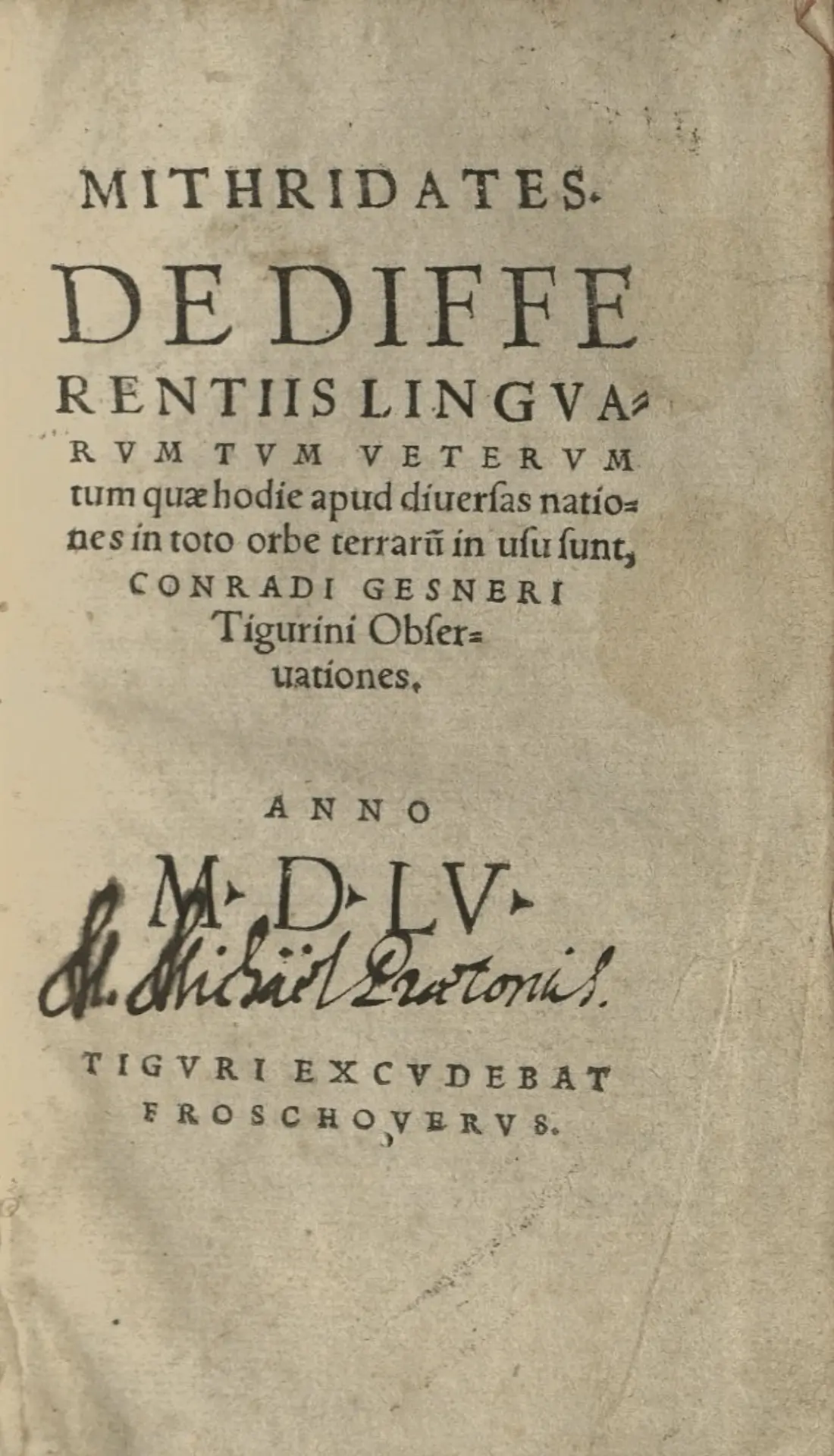
At the beginning of 2024 we acquired from the Heidelberg antiquariat Canicio a book from the possession of Michael Schultz (1599-1658), born in Torgau. This today not very well-known pastor, who liked to call himself Praetorius, had been a clergyman in Klettenberg since 1626 and was interested in languages. He therefore bought four philological works and had them bound together. The best known of them is Mithridates. On the Different Languages by Conrad Gessner, printed in the year 1555 by Christoph Froschauer the Elder in Zurich. Mithridates is regarded as the first work of comparative linguistics. It is also testimony to the collaboration of a dream team of Reformation publishing. We introduce you to Christoph Froschauer, the publisher, and Conrad Gessner, the author, in this contribution from a somewhat different perspective. But for this we must first go back to the year 1515.

The End of an Economic Era
Let us for a moment forget everything we think we know about the Zurich Reformation. Let us for once regard it from a different angle and concentrate on its economic aspects. For this we must begin with an important source of income for Zurich in the pre-Reformation period: the mercenary trade.
Mercenaries were called Reislaeufer at that time. Unlike today, a Reislaeufer did not hire himself out directly to a client. He signed on with a commander who, as a kind of small entrepreneur, paid the mercenary out of his own pocket and in turn rented the troop as a whole out to foreign clients. The commander had to pay for the permission to recruit mercenaries in a particular territory. Sometimes directly to the town treasury; sometimes it was cheaper to give gifts -- that is, to bribe -- local dignitaries. In any case, the mercenary trade poured a great deal of money into the city. It also ensured that young men who could find no work and therefore represented a potential source of unrest went abroad. Zurich was a major player in the mercenary business and earned excellently from it.
Then came the year 1515 and the Battle of Marignano. Within two days, nine to ten thousand Confederates died or were seriously injured. A large proportion of them came from Zurich -- not from the city, but from the surrounding countryside. Many poor peasants lost family members. They held the Zurich authorities responsible. This discontent culminated in December 1515 in a bloody uprising that historians euphemistically call the Zurich Gingerbread War.
It was brutally suppressed. But many Zurich councillors learned from it what dangers the mercenary trade brought with it. They pressed for a ban. It is in this context that the appointment of Huldrych Zwingli as people's priest at the Grossmunster belongs. He was known as a critic of the mercenary system. As people's priest he was to preach against the mercenary trade with the full authority of the Church.

The Reasons for the Reformation: Not 'Either-Or' but 'Both-And'
That Zwingli also provided the religious justification for confiscating the rich properties of the Catholic Church solved a pressing problem: the holes in the city's coffers that had arisen through the elimination of the mercenary system were thereby stopped up.
Unemployment remained. What was to become of all those farmers' sons who were superfluous on their fathers' farms? New, labour-intensive enterprises were needed. Anyone who built one could count on the support of the Reformation city council, all the more so if he was an enthusiastic supporter of the Reformation.
And with this we arrive at Christoph Froschauer. He was born around 1490 in the small village of Kastl, near Altoetting. He learned the printing trade in Augsburg. In 1515 he made a stopover in Zurich during his journeyman wanderings. There happened to him what every journeyman dreamed of: a widow offered him her hand in marriage. As a dowry she brought the excellently equipped printing house of her late husband into the marriage.
When Zwingli came to Zurich in 1519, it probably did not take long before he made Froschauer's acquaintance. The two must quickly have noticed that their religious convictions were similar. Only thus is it to be explained that Froschauer agreed to the famous sausage-eating. On 9 March 1522, in his house and in the presence of Zwingli (who, incidentally, did not eat along), he violated Church commandment. Today we celebrate him for it as a pioneer of the Reformation. At the time it was a great risk that could have cost him his livelihood. The council even instituted an investigation. Zwingli defended Froschauer with powerful voice. In 1523 Zurich introduced the Reformation.

The Great Business of the Printers with the Reformation
And with this Christoph Froschauer was a made man. For he enjoyed the full support of the Reformed city government, while the book market was booming. Books by the Reformers were developing into bestsellers, as the theologian Johann Eberlin von Gunzburg had already noted in 1524. He writes (translated into modern German): 'The whole world revolves around buying and selling. ... Take the example of the printers and publishers. Just look at how little the printers concern themselves with whether a subject is wicked or good, good or better, appropriate or objectionable. They publish books one should be ashamed of, love stories and satirical songs, whatever comes to hand and is beneficial to the purse. ... Now they have taken to the Lutheran books, to Holy Scripture, but only for their income. So even God's word must serve their devilish greed. ... When the evangelical books no longer sell, they will print papal ones again.'
Zwingli had commissioned Froschauer with the production of his German Bible and had thus made him quasi the semi-official printer of the Zurich council. This commission brought the publisher a fortune. Many wealthy householders acquired their first book for 3.5 guilders. Not only in Zurich. Twice a year Froschauer sold his prints at the Frankfurt Book Fair, which was attended by traders from throughout the German-speaking world. In order to reach more readers and thus paying customers, the business-minded publisher had the texts translated from the Zurich dialect into New High German. This brought Zwingli's theses more attention and him more customers. That Froschauer was more of a businessman than a religious zealot is apparent from the fact that he declined printing commissions that would have particularly angered the Catholic side.

Beneficiary of the Reformation
Christoph Froschauer -- the little printer's apprentice from Lower Bavaria -- became a wealthy entrepreneur through the Reformation. He expanded his printing and publishing business, including distribution, with a paper mill. He also operated a bookbindery. It had turned out that those who 'only' bought a Bible had no connection to local bookbinders and therefore preferred to buy an already bound copy. The expansion also succeeded thanks to the preferential conditions that Froschauer received as an entrepreneur close to the government. Thus he rented rooms in the former Barefoot Friars' Monastery to set up his four presses, until he bought a large property at what is today the Froschaugasse, in which before the Reformation two dozen nuns had found lodging.

The Battle of Kappel
And then the Battle of Kappel on 11 October 1531 put an end to the fine business. Zurich's war of aggression failed miserably. Besides Zwingli, 26 members of the small and large councils, 25 clergy, and approximately 400 citizens were killed. That Christoph Froschauer was not among them he owed only to chance. There had been water damage in his paper factory the previous day that the boss was supposed to assess. Froschauer asked for leave, was in Zurich during the battle, and thereby survived with his life.
After the Battle of Kappel, the Zurich economy initially collapsed. Froschauer turned to the council: 'I have many employees and few printing commissions. I therefore beg for your help and advice so that I may have work.' The city fathers did what was possible, but Froschauer could not live on the printing of official mandates alone. So he sought a new business field. He gave up the Reformation books and concentrated on prints that interested scholars of all confessions. And with this we come to Conrad Gessner, one of his most important authors.

The Impecunious Son of a Furrier
Conrad Gessner, born on 26 March 1516, also did not come from a wealthy household. His father was a furrier -- he processed hides -- and earned so little that he could not afford to feed all the children born to him. He therefore handed over the five-year-old Conrad to the great-uncle of his wife. This was not unusual in those days. Johannes Frick, chaplain at the Zurich Grossmunster, had the means and the connections to provide the little boy with a proper education. That would not have been a problem: Conrad was clever, quick to learn, quite devout, and the Zurich Reformers generously promoted promising young men if they took up a spiritual career. But the Battle of Kappel threw Conrad Gessner's plans into disarray too. The already approved stipend was paid only sporadically. So the young man made his own way in Strasbourg, Bourges, and Paris. He read everything he could lay his hands on, formed friendships among his fellow students that would last a lifetime, and at the age of 19 made the greatest mistake of his life: he married.
A Marriage and Its Consequences
In doing so he violated an unwritten law of the Zurich clergy. One did not marry without one's own livelihood being secured through a benefice and the permission of one's superiors having been obtained! Especially not if one already had a guilty conscience. Zurich paid stipends to train theologians for Church office. Even though Gessner was devout, he did not feel called to the clergy, but was more interested in the natural sciences. A few decades later the rule was introduced for cases like his that on changing subject the stipend had to be repaid with compound interest. Conrad Gessner was spared this. He could not have afforded it either. For after he received his doctorate in Basel in 1541, one poorly paid position followed another. And with this we return to Christoph Froschauer.
A Promising Business Model
He was concentrating -- as we have related -- on new products that were of interest to all humanists, regardless of whether they subscribed to the theses of Luther, Zwingli, Calvin, or the Catholic Church. But this market demanded very specific manuscripts, of which there were far too few. Conrad Gessner needed money. Froschauer needed manuscripts. And so there came about a transaction that was entirely unusual for that time: Froschauer paid the author!
We know this because Conrad Gessner wrote to Heinrich Bullinger about Froschauer's payment in 1558: 'Who would have maintained me and mine, since I received a salary of only 30 guilders annually? How would I have bought myself a house? How could I have supported my relatives, my nephews and nieces, my dear, beloved mother?'
But for Christoph Froschauer too the collaboration paid off. At his death he left behind a book empire with printing house, publishing house, distribution, bookbindery, locksmith's workshop, joinery, together with dwelling house, garden, tools, and supplies, estimated at a value of 10,665 guilders -- in the year 1564 an immense fortune!

Mithridates
The collaboration was not only financially lucrative but also a gain for scholarship. We present today the book that stands at the beginning of comparative linguistics: in 1555 there appeared Conrad Gessner's Mithridates sive de differentiis linguarum tum veterum tum quae hodie apud diversas nationes in usu sunt -- in translation: Mithridates or On the Differences of Languages, both the Ancient and those in Use Today among the Various Nations.
Mithridates became a milestone with respect to its title, methodology, and multilingualism.
Let us begin with the title: why did a Zurich scholar name a book about languages after a long-dead ruler who controlled a territory at the edge of the then-known world? Well, Mithridates VI of Pontus lived from 132 to 63 BC. He went down in history as the last serious rival of the Romans. He fought the Roman Senate for several decades over supremacy in Asia Minor. Much more important in this context, however, is something else. While the Romans forced all their subjects to learn Latin, Pliny the Elder records that Mithridates addressed his subjects in their own language. Gessner writes (translated from Latin): 'That Mithridates, the King of Pontus, as the only mortal spoke twenty-two languages is certain, and from the subjugated peoples not a single person was ever addressed by him through an interpreter in the fifty-six years that he reigned.'
And with this we come to the political fuel this investigation offered. While the Roman Church -- as successor to the Roman Senate -- still relied on the Latin language, most of the Reformed wrote in the vernacular. With his comparison of the various languages, Gessner placed German on the same level as Latin. It would be a long time before the equal status of the national language with Latin was generally recognised.
Let us also cast a glance at Gessner's methodology. He compares the various languages using the Lord's Prayer, a procedure regarded today as of limited value. What fascinates us is the different way of thinking conveyed through different languages. Gessner concentrated exclusively on the words -- even grammar plays hardly any role.
The Mithridates also reflects the Eurocentrism of the 16th century. While Gessner identifies more than the 72 languages postulated by Genesis (Gen 11:1-9) in Europe, for him the languages of Asia exist only in rudimentary form, Africa is entirely ignored, and the new world of the two Americas is dealt with in two pages.
At least a beginning had been made. In the next instalment of Bookophile we will concern ourselves with another work of the successful duo Froschauer/Gessner, the famous Thierbuch (Book of Animals). But in a considerably later and abridged edition.


