


Charles Darwin and the Theory of Evolution: The Stronger Survives
by
Ursula Kampmann

Charles Darwin and the Theory of Evolution: The Stronger Survives
Charles Darwin’s theories of evolution laid the foundation for our modern worldview. His hypothesis—that nature itself engages in natural selection, thereby creating new species—rendered any divine intervention unnecessary. For us, this is no longer a scandal. In Darwin’s time, however, it transformed the way people viewed the world.
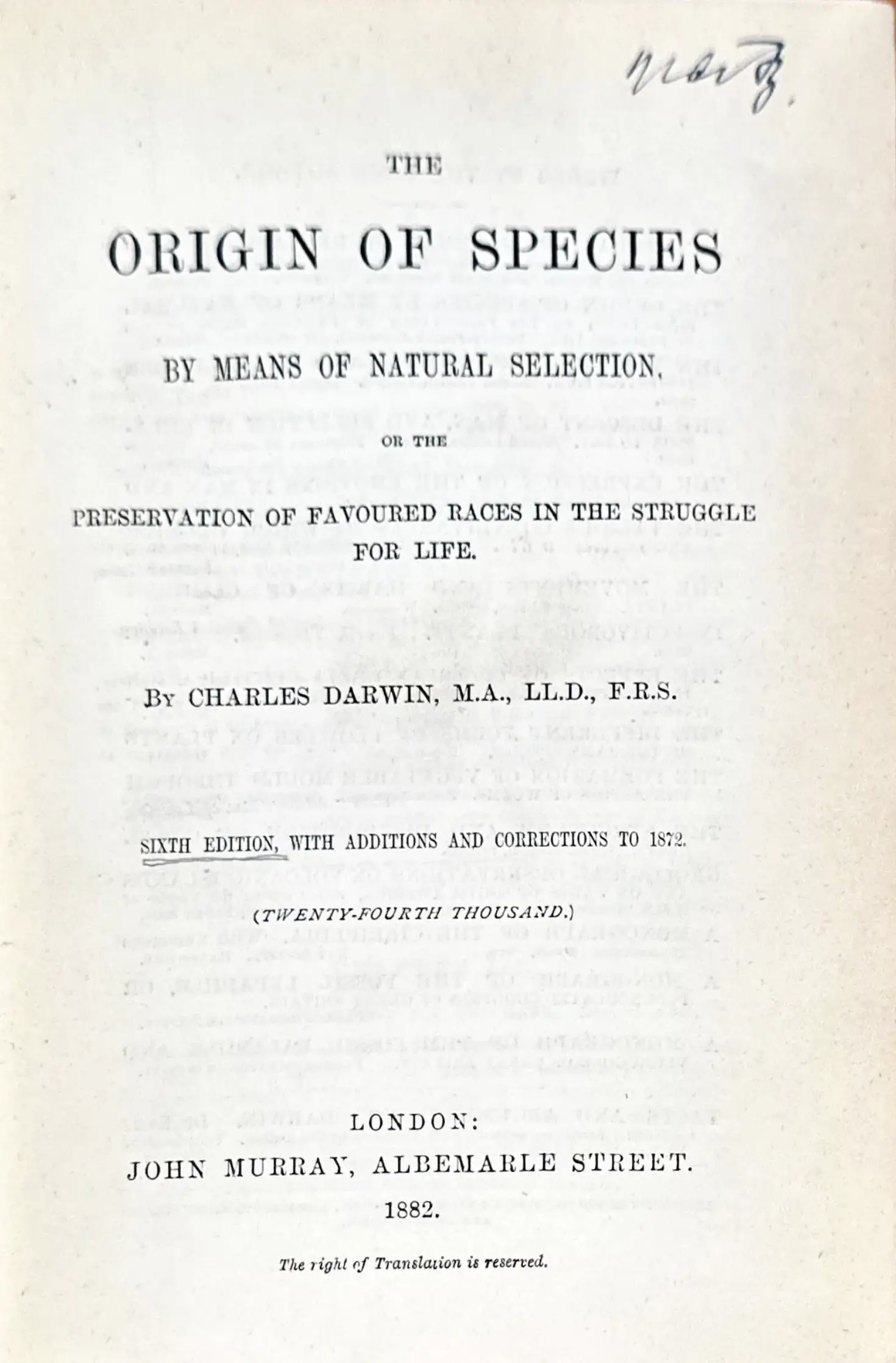
In 2022, the MoneyMuseum Zurich succeeded in acquiring at the Bern antiquariat Daniel Thierstein the work of an author who has permanently shaped our world view: Charles Darwin. With his name we associate the theory of evolution and natural selection. But what is meant by this? And what does the economist and demographer Thomas Robert Malthus have to do with Darwin's theses?

Artikeltext:
Breeding: New Animal Species for a New Age
Charles Darwin, born on 12 February 1809, lived in a world in upheaval: small manufactories were becoming large factories; many people were leaving their villages and seeking work in the city; they swelled the urban population, which no longer produced its own food but bought it. To prosper economically, the cities thus needed a secure food supply that traditional agriculture could no longer provide.
That is why new, more efficient cultivation methods were needed, new, higher-yielding grain varieties, and above all new animal species adapted to requirements. They provided, according to need, more meat, more milk, or more wool. Breeding them developed above all in England into a hobby of the wealthy gentry, a new class of landowners who owed their standing not to the hereditary nobility but to their wealth. The father of Charles Darwin belonged to this class. His grandfathers on his father's side was a famous natural scientist; on his mother's side the wealthy ceramics manufacturer Josiah Wedgwood. And so the small, extremely interested in natural science Charles Darwin probably learned already in earliest childhood how one systematically selects animals for breeding that display exactly the properties one wishes to develop further in a new species.

The Voyage on HMS Beagle
For Charles Darwin the family wealth meant even more than this. The whole world was open to him. First the family paid for a medical degree in Edinburgh. When he abandoned that, it financed his theology degree in Cambridge. And when the young Charles showed no inclination whatsoever for the priestly calling, his father raised the money to enable him to make the journey of his life. For Charles Darwin had from earliest youth been interested in nature in all its manifestations. He spent hours in the mountains understanding how rock formations had come about; he gathered botanical specimens and drew birds, insects, and mammals. He dreamed of discovering the nature of other countries, and when the opportunity presented itself to sail on HMS Beagle to Patagonia and Tierra del Fuego, he seized it. This voyage on the Beagle in the years between 1831 and 1836 became a key experience for Charles Darwin. More than that: it made the bright and industrious researcher instantly known throughout the scientific world. For Darwin described in numerous letters not only what he saw on the voyage, but simultaneously offered interpretations worth discussing. His friends published the letters, and so the members of the Royal Geographic Society were already impatiently awaiting the return of the gifted researcher when the Beagle sailed back to England.
A Different World
The importance of this voyage for the theory of evolution cannot be overestimated. In the nearly five years Darwin collected enormous quantities of material. Some of it matched what he had hitherto learned, other parts posed open questions for him. What about, for example, those fossils he discovered in the limestone? What about the tortoises of the Galapagos Islands? Their shells differed so clearly that the locals immediately knew from which island a tortoise came.
When Charles Darwin returned to England, there were stored in the hold of the Beagle 1,529 species preserved in spirit and 3,907 numbered complexes of skins, furs, bones, and plants, more or less unknown in England. Cataloguing and publishing them occupied Charles Darwin in the following years.

Species Change
For his catalogue, Charles Darwin drew on a method used worldwide since Carl von Linne to describe plants and animals unambiguously. Linne had attempted a classification of the entire living world, assigning each individual to a species, genus, and family. Since Linne, a domestic cat is no longer merely a cat but Felis catus from the genus of true cats, from the cat family, and the order of carnivores. In order to fit an individual into this order, one must compare it with many other individuals and in doing so check whether it displays all the species-specific characteristics.
For Charles Darwin this meant that before each catalogue entry he had to decide whether the specimen before him belonged to an already known or to a new species. The problem was that Darwin frequently had very little comparative material available. He was therefore constantly confronted with the question of whether a specimen that resembled another but was not identical simply showed individual deviations -- zoology speaks in such a case of a variety or subspecies -- or whether these deviations were so striking that a new species was present.
This work sensitised Darwin to the incredible range of variation within individual species and to the fact that species were frequently geographically and temporally bounded. He saw that in spaces isolated from one another, closely related species lived. At the same time fossils showed great similarities to still-living animal species.
This observation was confirmed by collaboration with other researchers. The internationally renowned ornithologist John Gould classified the 31 bird skins that Darwin had brought back from the Galapagos Islands. He established that in some cases these were not different but closely related species. Zoology calls a group of birds he described Darwin's finches.
Darwin probably then conceived the thought that species did not arise only in the stables of the English gentry, but also in regions where no human being had yet set foot. He grasped that all living beings can change. We speak in this context today of evolution, from the Latin verb evolvere = to develop; Charles Darwin preferred the term 'transmutation' = transformation.
But how, Darwin asked himself, did this change come about? After all, there was no breeder on the Galapagos Islands who systematically selected finches with quite particular properties for breeding.

An Interdisciplinary Inspiration
Charles Darwin pondered this question for a long time without reaching a result. The turning point was his reading of Thomas Robert Malthus's Essay On the Principle of Population, as he himself describes in his autobiography: '... [the question] of how selection could be applied to organisms living in a state of nature, [that is, as opposed to artificial selection through breeding] remained for some time a mystery to me. In October 1838, that is, fifteen months after I had begun my systematic researches, I happened to read for amusement Malthus On Population ...'
Now Malthus was anything but a natural scientist. He was an economist and had concerned himself with the problem of poverty. Malthus wanted to demonstrate through extensive statistics that systematic support of the poor would only lead to their having even more children and thus causing even greater poverty. This statement became a Copernican revolution for Charles Darwin. Before reading it he assumed that nature produces only as many individuals as the environment can feed. Afterwards, drawing on Thomas Malthus, he postulated that nature creates a surplus of life. Whether British slum dwellers, animals, or plants, they all wish to leave behind as numerous a progeny as possible. This creates such a quantity of individuals that not all can survive. Nature itself intervenes here to eliminate surplus individuals through hunger and disease.
And Charles Darwin interpreted this to mean that pitiless nature itself becomes the breeder. A living being that brings with it properties that make survival in a hostile environment easier will survive longer. Thus it grows older and has more frequent opportunities to produce offspring. Its descendants partly carry forward the especially useful genes. (Here the Mendelian rules come into play, but Charles Darwin did not yet know them.) Those who possess these genes survive longer, just like their ancestor, and have more opportunities to produce offspring. These in turn carry the genes further, but in higher concentration. This process is repeated until one day a new species exists, all the individuals of which possess these genes. Charles Darwin formulated his insight as follows: upon reading Malthus's relentless arithmetic, 'I at once saw that under these circumstances favourable variations would tend to be preserved and unfavourable ones to be destroyed. The result of this would be the formation of new species. Here, then, I had at last got a theory by which to work.'
Scandalous Ideas!
In his autobiography Darwin claims to have been convinced of evolution -- the transformation of species -- by the middle of 1837, and to have achieved the decisive breakthrough regarding natural selection with the help of Malthus in 1838. He did not publish his ideas. Instead he wrote geological works on coral reefs (1842) and volcanoes (1844).
This is remarkable. Darwin's opinion counted in the scientific world of Great Britain. And yet he did not dare to let the bomb explode. Instead he composed a 230-page essay on his thoughts. Even if he may have spoken with his friends about the subject, no one except his wife Emma was allowed to read the text. Darwin seems not even to have been certain whether he would publish it during his lifetime, for he entrusted Emma with the task of doing so after his death.
But why did Darwin hesitate to publish his results? To understand this we must enter into the political debate of that time.

The Church Struggle
Although the Enlightenment thinkers had for centuries demanded that religion be consigned to the museum, the majority of the population viewed these theses with more than scepticism. The French Revolution changed the attitude of Western governments not toward faith, but toward the Church. They grasped how useful it would be to get their hands on the financial resources of the Church, to displace it from poor relief, and to take over the education of new generations themselves. But since a broad majority of the population held fast to faith and could not imagine a faith without the established Church, a social debate arose throughout Europe. What role was the Church to play in the future? In Germany this dispute received the name Kirchenkampf (Church struggle). Darwin's theses thus fell not into a vacuum but were read against the background of this dispute.
Evolution itself met with little resistance. Everyone saw that species changed. While the gentry was experimenting with cattle and swine, in the cities there were rabbit and dog breeding clubs. Changing species at this point were nothing a devout Christian would have got worked up about.
But nature as a pitiless breeder who creates a surplus of individuals in order to let them fight for their existence in the arena of life -- that was not compatible with the idea of a benevolent God. Charles Darwin had understood this. He knew what explosive force his theses contained and therefore had good reason not to place them prematurely up for discussion.
On the Origin of Species
We will in another contribution relate how the public presentation of Darwin's theses on 1 July 1858 came about after all. The storm of outrage failed to materialise, so that Charles Darwin ventured to publish his collected material in the following year. The book was titled On the Origin of Species by Means of Natural Selection, or the Preservation of Favoured Races in the Struggle of Life. The 1,250 copies of the first edition that came onto the market on 24 November were sold out on the same day. Since then this so decisive treatise has been repeatedly translated and reprinted.
What is remarkable about this book is the fact that it truly laid the basis for our modern understanding of the world, which has since been confirmed in its details by many further investigations.
It contained five essential theses that in Darwin's time were pure postulates:
1.) Species change -- what we today call evolution
2.) All living beings have a common origin
3.) The change of species occurs in tiny small steps
4.) Within a population, different species can arise
5.) Natural selection is the most important, but not the only, mechanism of evolution
Darwinism and Creationism
While evolution itself quickly found recognition, natural selection remained controversial long after Darwin's death, which did not diminish his veneration at all. Darwin was buried at the feet of Sir Isaac Newton in Westminster Abbey with worldwide participation.
Today we regard Darwin's theory as the only defensible truth, even if it is vehemently contested by some groups. For Darwin's world view calls into question the goodness and the omnipotence of God, and so it should come as no surprise that Darwin's sharpest critics do not come from Judaism, Christianity, or Islam, but that it is the orthodox believers of all three religions who reject Darwin and instead profess creationism.


