


Chaka the Zulu: Work-Life Balance of a Zulu Chief
by
Ursula Kampmann

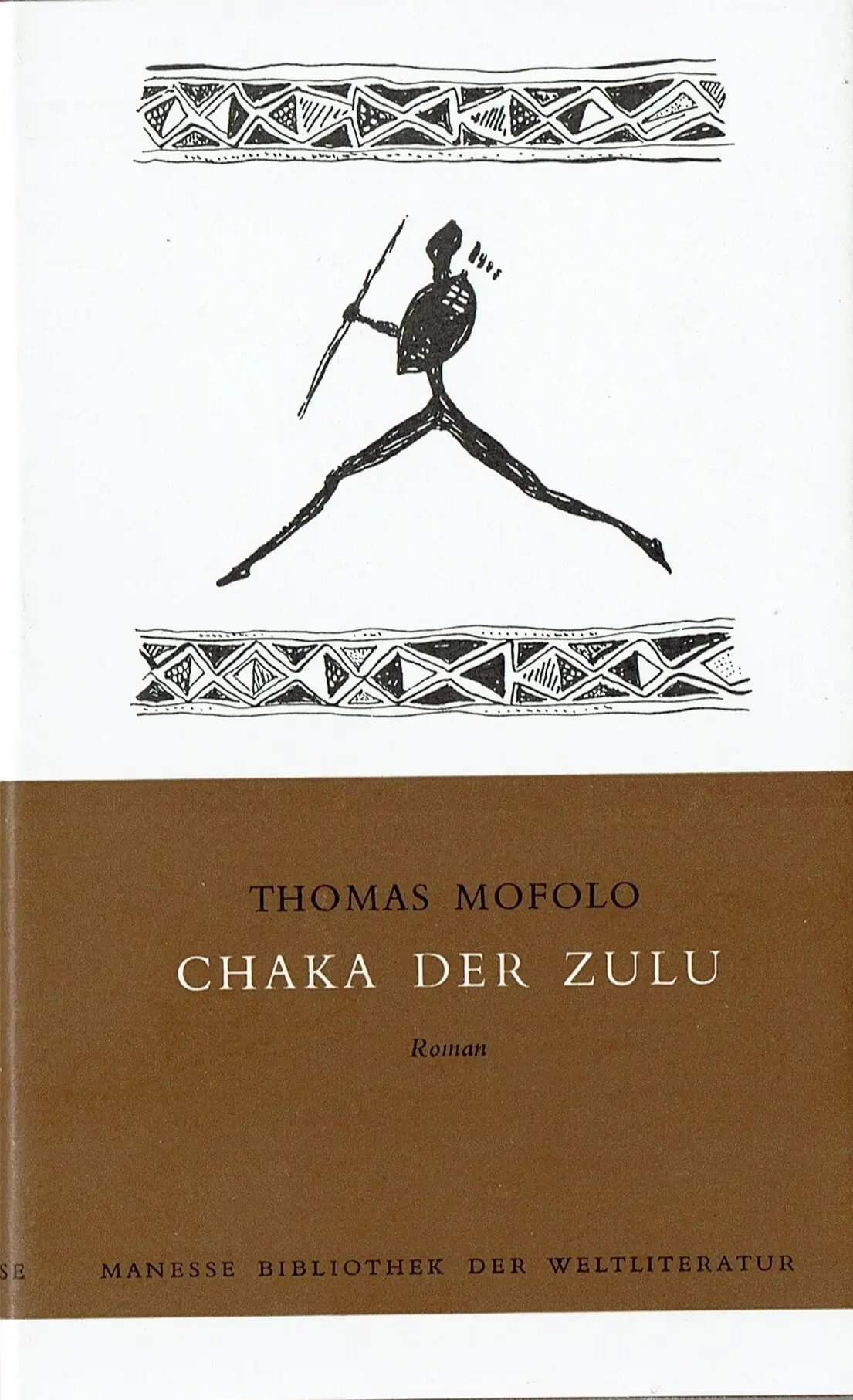
In 1953, the Manesse Library of World Literature published Chaka Zulu, the German translation of the novel Chaka, which the Mosotho Thomas Mokopu Mofolo had written in 1926 in his mother tongue, Sesotho. For that era, this was an extraordinary testimony to tolerance, proof that those in Zurich were serious when they spoke of a Library of World Literature. Consider: in 1953, equal rights for people of different skin colours was still a distant dream. The decolonisation of Africa had only just begun; the Montgomery Bus Boycott would not take place until two years later; to say nothing of Mofolo's homeland, South Africa, where it would be another 40 years before his descendants received the same rights as white immigrants. Even if the commentary and translation of Chaka Zulu systematically use the N-word, this should not be understood as a sign of intolerance, but as the vocabulary common at the time in a book that pays homage to a work of world literature previously largely unknown in the German-speaking world.
In fact, the story that Thomas Mokopu Mofolo tells is anything but an idyllic novel about the noble savage. Instead it addresses a problem as old and as universal as humanity itself. At the centre stands the question of how much a person is willing to sacrifice for power.
The hero of the story is a historical figure. Shaka ka Senzangakhona, born around 1787, ruled the Zulu from 1816 to 1828. Under him, the previously insignificant tribe rose to become the decisive power in South Africa. The reason was Shaka's calculated cruelty. He employed a tactic previously unknown. Before Shaka, combat between South African peoples was highly ritualised. There were few fatalities before a decision was reached. Shaka, by contrast, relied on the mass annihilation of his enemies and their families. It is said that his soldiers may have killed up to a million people during their campaigns of conquest. This epoch is still known today as the Mfecane, a term from the Zulu language meaning something like crushing or scattering. Indeed, some modern historians even claim that it was this loss of human life that facilitated the later settlement of the land by the British and the Boers.
Thomas Mofolo was not a Zulu. He belonged to the nation of the Basotho, who had been forced to flee before Shaka and his warriors. His ancestors were therefore not only victims of the English and the Boers, but also of the Zulu. Mofolo himself had not lived through these wars. He was born in a pacified land, embraced Christianity, and received a Western education at a mission station.
Yet the figure of Shaka must have preoccupied Thomas Mofolo. He knew the oral tradition about the ruler through which storytellers in South Africa preserved the past. Mofolo systematically collected their knowledge in order to reshape it into a novel following a Western model.
Mofolo crafted a brilliant novel of development. The reader accompanies the butcher of South Africa from earliest youth, when the illegitimate and unwanted Chaka -- as Shaka is called in Mofolo's work -- fights back against the cruelties of his peers and grows strong and gains experience in combat. Chaka does find a new home, and he wins the love of a wonderful woman, but it is too late. Virtually compulsively, he must eliminate one rival after another to prevent them from uniting against him.
He gains the support of a powerful sorcerer. To him he owes his success, but for each new level of power the sorcerer demands an ever greater sacrifice from Chaka. And so Chaka wins power by forfeiting all his private happiness. The novel reaches its climax when Chaka, in exchange for the ultimate talisman, murders his beloved wife with his own hands.
Thus public success is bound up with private misery. The end is foreseeable: Chaka loses all support within his family. His own brothers lie in wait for him and kill him.
Even if a modern career naturally demands no fatalities, the questions Mofolo poses are nonetheless thoroughly contemporary: when someone seizes power, what is the relationship between private and public success? What sacrifices does the ascent demand? Who must make them? And is it possible to rise to the top while acting with moral responsibility?
Thomas Mofolo says no. He condemns Chaka's conduct. Why he does so is debated among literary scholars. Is his judgement based on his own personal values and the values of his people? Or has he, as a pupil of a mission station, internalised Christian values? We do not know. What this novel teaches us, however, is that it would be arrogant to locate guilt exclusively among people of one skin colour. Such a claim disempowers all other people, who possess the same capacity to make morally wrong decisions and to do evil.


