
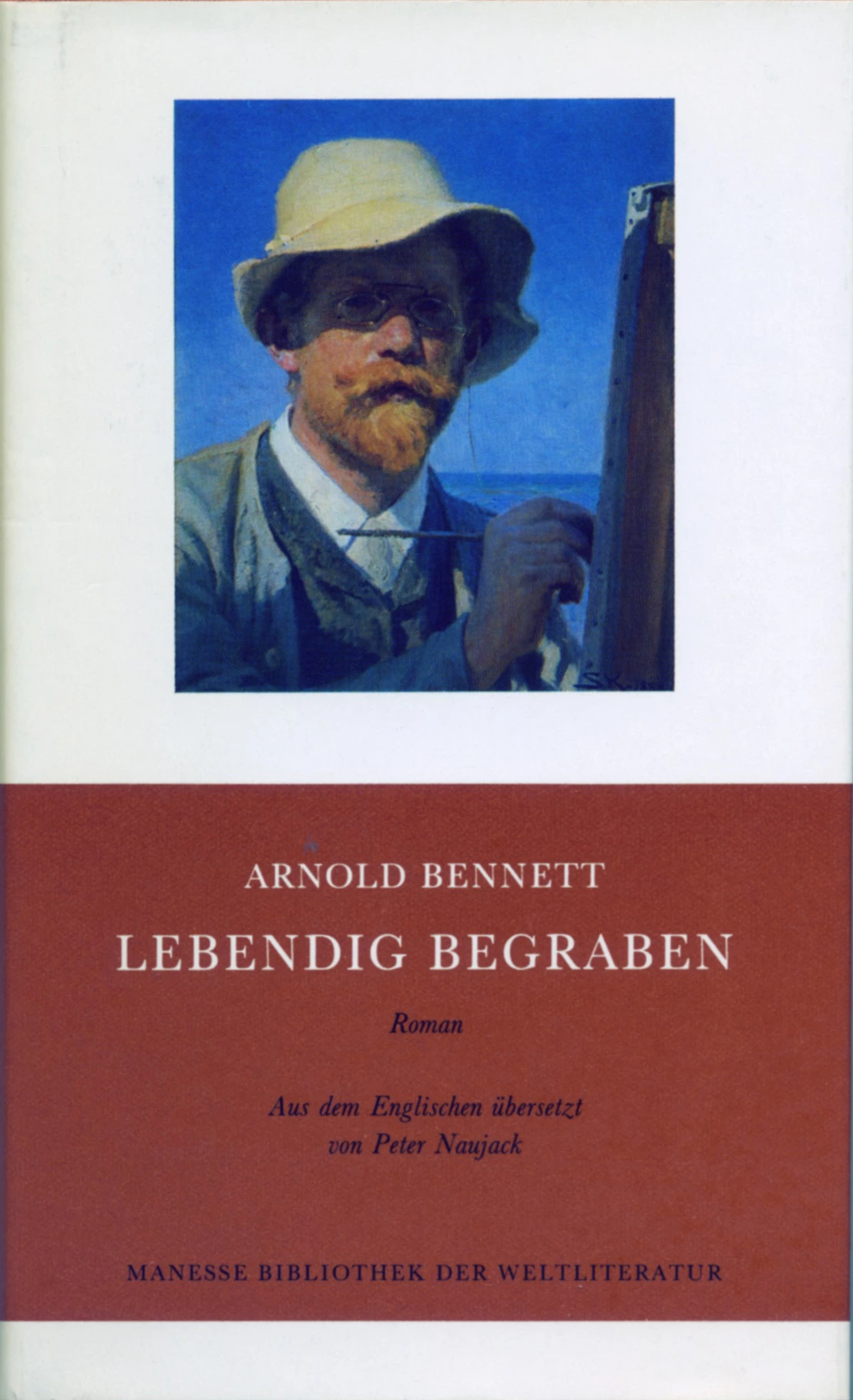


Buried Alive: The Star, His Shyness, and the Copious Money
by
Ursula Kampmann

He was simply brilliant -- no, by that I do not mean the author Arnold Bennett, but the main character of his novel 'Buried Alive.' The protagonist's name is Priam Farll and he is not a writer but a painter; a painter who moves the popes of modern art to hymns of praise, sends self-appointed art connoisseurs into raptures, and of whom even the general public knows it must find him wonderful. Priam Farll can therefore charge whatever he likes for his paintings -- a task his art dealers gladly perform for him, pocketing a (very) large portion of the associated profit for themselves. With this Priam Farll pays for the privilege of being able to hide from the curious world. For the good man is shy and wants nothing more than to paint in peace.
A manservant largely keeps the world at bay for Priam Farll. Not out of any genuine affection, naturally, but because he earns excellently at it. His master is far too shy to keep an eye on his employee. And so the real Priam Farll also does not know that the servant uses his, Farll's, photograph to respond to matrimonial advertisements. And so a splendid comedy of errors comes about when the servant dies unexpectedly, and his master in the worn, always-secretly-worn dressing gown is taken for the servant by the summoned doctor. The death certificate is made out in the name of Priam Farll, and he is naturally far too shy to clear up the error. And so the false Priam Farll is buried with the greatest attention of the press, the art world, and all who wish to present themselves as connoisseurs of art, in Westminster Abbey.
But even before the funeral takes place, Priam Farll's heir -- a relative who last saw him at the age of nine -- throws him out of the house. The only good thing about it is that Farll's servant had before his death arranged a meeting with a widow willing to marry. By chance this meeting occurs; Priam Farll pleases the widow, and she marries him.
The marriage is for Priam Farll an entry into paradise, for his wife cares for him with all the efficiency attributed to an experienced widow in England at the turn of the century. The successful painter, who was once fitted by the most expensive tailors on the continent for smart but thoroughly uncomfortable bespoke suits, learns to love the comfort of a worn-out waistband. He grows rounder and rounder, because he is no longer talked into the most exquisite (and most expensive) delicacies of the house by supercilious waiters, but his wife cooks his favourite dishes. She even buys him the costly paints so that he can produce pictures in the small but well-heated attic room. What then completely astonishes her, however, is the fact that the local grocer sells her husband's daubs for an incredible 10 pounds apiece.
These paintings then lead to the painter's resurrection -- though against his will. For it turns out that his former agent acquires his newly painted pictures from a middleman for 50 pounds apiece in order to resell them to an American collector for several thousand pounds each. The collector discovers one day that one of the pictures must certainly have been created after Farll's death. A forgery?! Are all the posthumously purchased pictures forgeries?! The collector believes so and takes the art agent to court. The agent seeks to win Farll's assistance, but makes the strategic error of offering him only half his profit of 72,000 pounds. Farll is outraged. He leaves the greedy art dealer to his fate.
But the dealer strikes back. He has Farll summoned against his will as a witness in the high-profile case between art agent and collector. With that the quiet life is over. The public demands its rights. And when the dispute over the identity of the shy painter seems to reduce itself to proving he has two birthmarks on his neck, Farll steadfastly refuses to remove his collar. Only when the art agent threatens to expose a former (equally shy) mistress of Farll's to public ridicule does Farll, out of sympathy with a fellow sufferer, show his birthmarks -- and flee with his wife to foreign lands where he will (hopefully) find his peace.
With his witty satire on the art market, Arnold Bennett has created a parable that is more topical today than ever: What claim does a public have to participate in the life of the artist? Must a celebrity, simply because they are famous, forgo all the comfort of a private life?
We should remember that the word 'fan' is nothing other than an abbreviation of the English 'fanatic.' Since the 16th century this was used in England to describe believers whose religious mania exceeded every human measure. But how does a modern fan community deal with its reluctant god when he refuses to serve them as an object of veneration?


