
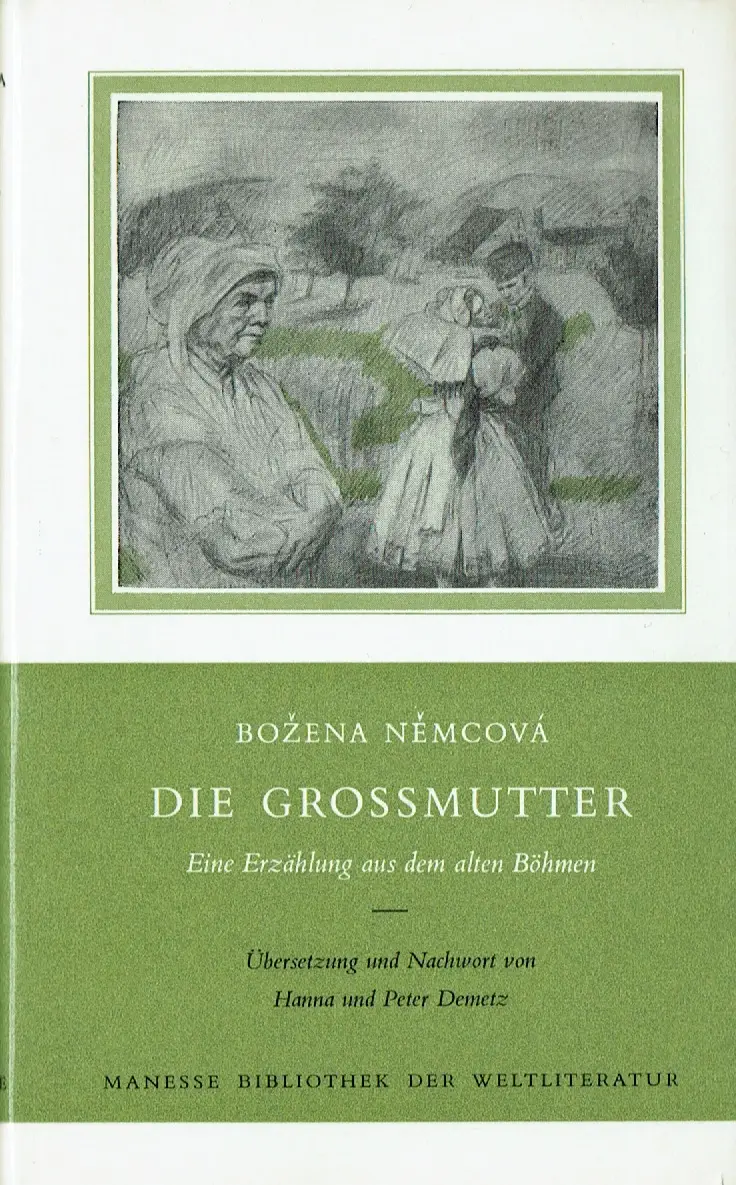


Babička: Or Can Old People Make a Difference?
by
Ursula Kampmann

Have you ever heard of Babička? No? Well, if you lived in the Czech Republic, you would most likely have read this story at school. With around 350 editions, it is one of — if not the — best-selling piece of Czech prose, and not only because of its content. With this book, Czech became a literary language. But that, of course, would be no reason to read Babička today. Fortunately, the plot of Babička still fascinates: it portrays an old woman whose brutal fate has made her not bitter but wise. Drawing on her experience, she prevents other women from suffering the same fate as herself.
Of course Babička — Grandmother — also has a proper name, but no one uses it. We first encounter her upon her arrival at her daughter's small estate. She comes not as a burden, not as an unwanted care case, but to help her child manage the household. And there she stands, with her few possessions that fit into a single trunk, her white hair, her old-fashioned dress, and her last four teeth. She is the very archetype of a worn-out woman, and yet in no time at all she has become the heart of the small estate. Her strength lies in taking time — for the children, for the livestock, and of course for all the poor and unloved who knock at her door. Those who are hungry receive a piece of bread from her, and often her own share of butter as well. Those who have worries are listened to. Those who seek her counsel receive it, without reproach or know-it-all advice.
The village Němcová describes in her story is an idyllic one. And yet she does not conceal that injustices exist there too. Young women in particular become victims: there is the mad Viktorka, whom a soldier has driven out of her mind. Did she love him when she followed him to his military encampment, long years ago? What can have happened to her there? Němcová does not tell us, leaving everything to our imagination. In any case, Viktorka returned to the village some months later, alone and pregnant. No, she did not dare go to her parents; she preferred to hide in the forest. Somewhere in that solitude her child came into the world. Did it live, or was it already dead at birth? Some even say Viktorka smothered it herself. Since then she has not spoken a word. She lives in the forest — if one can even call it living, this self-imposed prison camp of cold, poverty, and silence.
How differently Babička has dealt with her own fate! War has done terrible things to her as well. Her husband was pressed into military service. He had to fight the Poles for the Prussians. And in doing so, a cannonball tore off his leg. He died miserably from the wound. No one gave him even a sip of water. How could Babička have lived in a Prussia that let her husband die in such a way? She turned her back on the meagre pension that would have been her due as a soldier's widow and returned to her native Bohemia. She worked her fingers to the bone and in doing so secured a future for her children.
All long past? Not at all! In Němcová's story, two women are threatened with much the same fate. Kristla works in the inn — a decent girl who loves an upright farm lad and is loved in return. Unfortunately the arrogant official from the castle has taken a fancy to her. Nothing serious — he is married. But he would not object to a little dalliance. He threatens Kristla that he will have her sweetheart conscripted if she does not comply with his wishes. And indeed, when Kristla refuses him, he ensures the farm lad is drafted. In those days that meant twelve years of military service. Only the fewest returned afterwards. But it is not only ordinary women who have their troubles. There is also the beloved daughter of the countess. For her, the devoted mother arranges a marriage. The suitor is wealthy and handsome. Love? That was of only marginal interest in those days. And yet the count's daughter loves another with every fibre of her being. Naturally she will tell no one. She has been too well brought up to rebel against a mother's command. So she pines away in the face of her loveless future.
All of this Babička sees. What is it to her? Men have always been pressed into service, soldiers have always died, women have always endured loveless marriages. But Babička is not like that. She steps forward and makes use of her possibilities. Alone she has no power. She is old and poor; and yet she succeeds — this powerless woman — in holding the powerful to account. She informs the count and countess, and so achieves for the two young women what she herself was denied: the happiness of being united with the one they love.
An idyll? Yes, people have wished to call Božena Němcová's story that, but too many details of Babička are autobiographically shaped. Němcová herself was an illegitimate child, the daughter of a washerwoman who served the Duchess Wilhelmine of Sagan. The Duchess must have been an impressive personality: rich, beautiful, and powerful, and superbly well connected. Prince Clemens von Metternich is said to have been her lover. And here the legend begins: was Němcová really the daughter of the washerwoman? Or the fruit of a noble mesalliance? A child of the Congress of Vienna, which brought the crowned heads of Europe to the Viennese court? That is not improbable. At any rate, the Duchess ensured that the little washerwoman with her illegitimate child was not dismissed but given a position on the ducal estate at Ratibořice and married to the household coachman. He gave Němcová his name. She received on the Ratibořice estate a far better upbringing than would have been her due as the illegitimate offspring of a washerwoman in those times.
All's well that ends well? No, for like the grandmother, Němcová leads anything but a peaceful life! She marries a patriot. Perhaps he once loved her. But he is far too preoccupied with the nation to concern himself with a family. Work? He couldn't care less about his well-paid civil service post. He brings no money home, but beats his wife and children. In 1861 Němcová finally flees their shared home. Now she must earn money for her small family herself. Then her son dies. In this desperate situation she escapes in her imagination back to her sheltered childhood on the Ratibořice estate and writes Babička. It is almost a miracle to see with what qualities she endowed her alter ego, the ancient Babička. There is no trace of bitter fear of a lonely old age. On the contrary, she allows Babička to give back all the good she herself received as a child at Ratibořice.
While we often slander our pensioners as superfluous, Babička in her helpless powerlessness is more effective than ever. Which conception is closer to reality? Well, even in old age, every person should be able to have a say in what they do with their life.


