
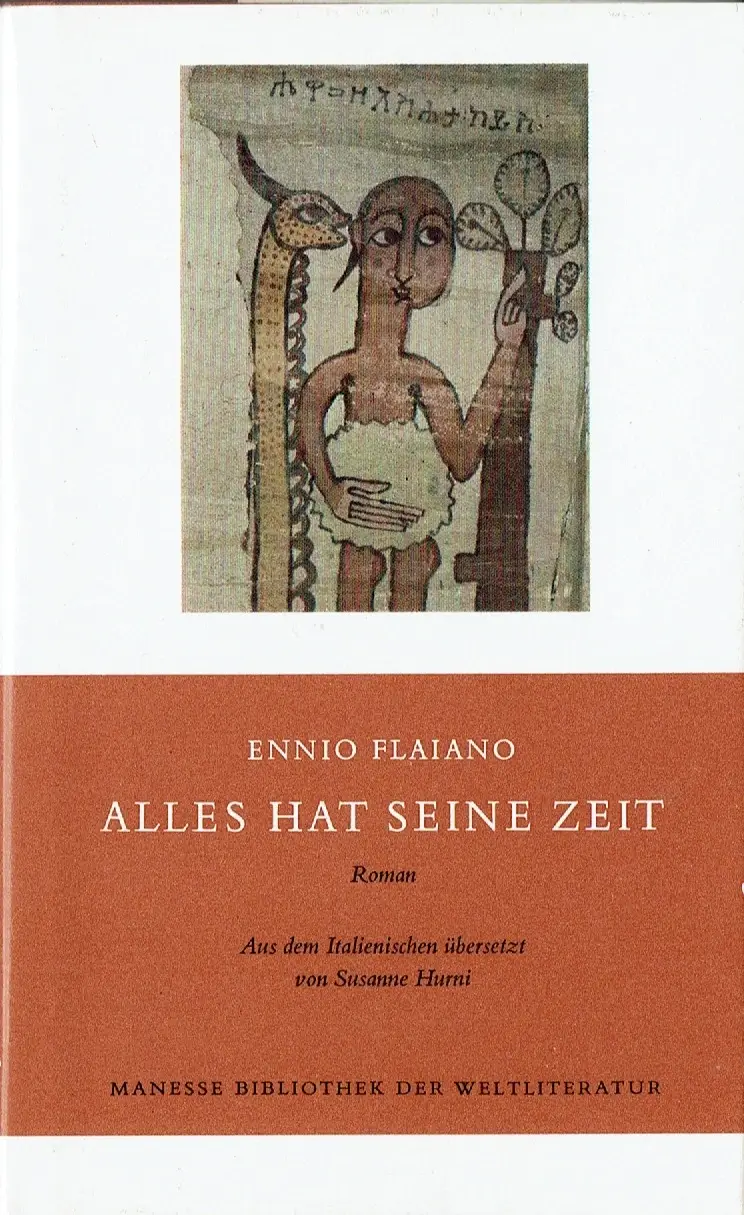


To say it straight away: it is not a book one reads in a single sitting. It is a book one struggles through, constantly setting it aside to escape the pull of a story that so inexorably steers toward the abyss before offering something like a happy ending at the last moment -- if there can even be a happy ending for a murderer.
The Absurd Plot
For a murderer is that officer who stumbles through the desolate deserts of Abyssinia. And the reader witnesses at least one murder. Or is it even a murder? Is it not rather a terrible accident, a chain of unfortunate coincidences, that leaves a young, beautiful Abyssinian woman dead on the ground? He only wanted to rape her, that officer, just a bit of fun and then move on. And the woman had been so willing! But then he was startled, fired, and somehow -- a ricochet? -- there is suddenly a large hole in her body. Perhaps a doctor could save her, but the way is long, the chance slim, many questions would have to be answered, so the officer puts the pistol to her forehead and shoots her dead. No matter. The village she came from will be destroyed that very night anyway. It is one of many that a massacre by the Italian military will wipe from the map. So she would have been dead anyway, whether shot on orders during one of the many massacres or at his own decision.
But then a few days later strange spots appear on the officer's hand. He consults a doctor and interprets his behaviour to mean that the Abyssinian woman has infected him with leprosy. He cannot return to the army. He would be isolated and a journey home to his lover would be gone forever. So the officer wanders through war-ravaged Abyssinia until an elderly Abyssinian man takes him in and nurses him back to health. The officer believes him to be the father of the woman he shot and interprets the healing as a sign of forgiveness. As the title of the book suggests: there is a time for everything -- a time to kill, a time to heal. So says the Old Testament at least. And for Flaiano it was 'Tempo di Uccidere.'
But one might also put it as his comrade does: 'The others are too busy with their own crimes to notice ours.'
An Italian Biography
The person who conjures up this strangely absurd episode from the Abyssinian War is Ennio Flaiano, born in 1910 and one of the best-known intellectuals of postwar Italy. The highly educated son of a merchant is a columnist, playwright, and screenwriter. Among his best-known works are Fellini's classics 'La Strada,' 'La Dolce Vita,' and '8 1/2.' Flaiano is known for his razor-sharp analyses and for the ironic lightness with which he enchants an urban audience.
And then there is in his oeuvre that monolith which does not fit: his only novel, which Flaiano wrote in four months shortly after the end of the Second World War. It is his book about the Abyssinian War, in which the author himself participated.
The Fascists' First War
The 25-year-old Flaiano, like hundreds of thousands of others, received his conscription notice in the autumn of 1935. Il Duce was planning a great war that would become the first war of aggression waged by a fascist-governed country. Accompanied by waves of enthusiasm from the Italian public and blessed by the Catholic Church, the fascist troops crossed the border into Abyssinia on 3 October 1935. Abyssinia was a full member of the League of Nations and one of only two African countries governed by an indigenous government. A declaration of war? No. Of course not. Believing themselves a superior race, the Italians believed they had a claim to more living space. Against dark-skinned people all means seemed permissible to them, especially when initial successes were followed by setbacks and an exhausting guerrilla war. Hundreds of air raids were carried out, tens of thousands of fragmentation, incendiary and gas bombs dropped, chemical weapons deployed. Italian soldiers systematically shot the livestock of peasants and nomads and burned entire regions to the ground. That Flaiano's officer wanders through a barren landscape in which no tree gives shade is not due to the nature of the country but to the thoroughness with which the Italian army destroyed all the trees of Abyssinia. That was just one of the countless crimes against humanity that Italian soldiers committed in this war. Massacres, gang rapes, attacks on Red Cross field hospitals (seven deliberate, one collateral damage), the systematic execution of all captured soldiers, concentration camps that became death camps -- to name but a few. That no biological weapons were deployed was only because the level of development did not yet suffice for that. But even so, hundreds of thousands -- estimates reach up to 760,000 -- Abyssinians were killed and even more traumatised, before it proved possible to liberate Ethiopia in the course of the British African campaigns of the Second World War.
Dealing with Guilt
Flaiano's hands too will not have remained clean in the process. As an officer he must have issued orders and seen their consequences. But the homeland to which he returned celebrated him as a hero. For a war crimes tribunal of the kind held in Germany and Japan did not take place in Italy at the wish of the Allies. They did not want to risk losing reliable allies in the Cold War. After all, some of those chiefly responsible for the atrocities of the Abyssinian War served as respected conservative politicians in postwar Italy. They made sure that Italy did not drift toward the Communism then widespread in the country.
No Italian was ever called to account for his crimes against the Ethiopians. And so the many hundreds of thousands of soldiers who had been involved in these crimes carried their guilt in secret, got away with it just as Flaiano's officer got away with his murder of the Ethiopian woman, without anyone even taking an interest in his crime.
Bad Dreams
Flaiano describes this condition in his novel as leprosy, which for him is far more than a disease: 'Perhaps it is no longer leprosy but a still more subtle and invincible evil inflicted on us when experience brings us to discover what we truly are.'
My own father too, as a small boy of 13, witnessed the heavy bombing raids on Munich. He never spoke about it, but laid out his clothes for the next day for the rest of his life so that he could find them even in the dark. In the weeks before his death he cried out loudly in his sleep every night. Out of fear of the bombs? Out of despair at what he had to see in bomb-ravaged Munich? I want to know whether Flaiano too, before his death, saw the broken eyes of his victims in his dreams.


